

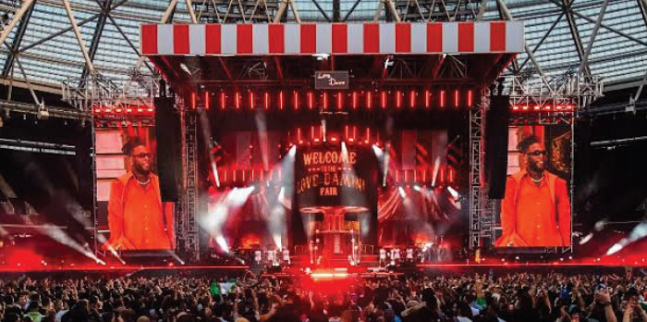
At was an arresting spectacle, the kind that stills the breath before it steals the heart. A living, breathing constellation of music lovers stretched endlessly beneath the lights of the 32,000-capacity Madison Square Garden in Midtown Manhattan. A sea of heads, swaying and shimmering, as though the night itself had learned how to dance.
More than 30,000 people—Black, white, Hispanic, French, English, and everything in between—gathered shoulder to shoulder, their differences dissolving into one shared rhythm. Voices rose in unison, singing every lyric at the top of their lungs, surrendering fully to the mellifluous beats pouring from the stage. In that moment, the music did not merely play; it possessed. It fused souls, blurred borders, and rewrote geography.
Then came the glow. Thousands of phones lifted skyward, flashlights blazing like stars summoned on command. It was more than spectacle; it was affirmation. An unfiltered declaration of love for a Nigerian artist commanding one of the world’s most iconic arenas—deep in Midtown Manhattan, in what many still call “God’s own country.” For any Nigerian in that hall on that electrifying night, pride was unavoidable. This was not just a concert. It was a coronation.
Afrobeats—once dismissed, misunderstood, and confined to local airwaves—had arrived. No, it had conquered. But like all great triumphs, this moment was born of improbable beginnings. What now feels inevitable once seemed impossible, even absurd. For decades, Nigerian music barely whispered beyond Africa’s shores. International recognition was a distant mirage, shimmering but unreachable. When early pop acts like Eedris Abdulkareem, under Kennis Music—the powerhouse label of Nigeria’s early-2000s pop era—travelled to the United States and released visuals for his hit single “Live in Yankee (Marry Me)”, it felt monumental. Almost mythic. Yet, in reality, it was modest. No stadium tours. No global chart domination. No sold-out arenas. Just a trip, a video, and a daring dream. Still, that moment mattered. It marked the fragile first steps of a genre that would later run, leap, and soar. Afrobeats—an evolution inspired by Fela Anikulapo-Kuti’s Afrobeat—did not sprint into global relevance. It crawled. It dragged. It endured. And then, against all odds, it rose.
From the streets of Lagos to the grandest stages on earth, Afrobeats transformed itself into one of the most powerful cultural forces of modern pop history. Today, it does not knock on the doors of global music; it owns the keys. It anchors stadium tours, shatters streaming records, and shapes the sound and style of contemporary pop culture. From Lagos to London, New York to Paris, Dubai to Toronto, the Nigerian sound now defines moments that matter. It fills arenas, headlines festivals, and commands the world’s attention with confidence earned, not borrowed. It was destiny fulfilled. Afrobeats is no longer emerging. It has arrived—and the world is singing along.
In the streaming era, global music dominance is no longer debated through opinion or hype; it is measured by numbers. How often people hit “play,” and where those streams come from—whether in Lagos, London, New York, or faraway Germany—has become the most objective proof of cultural reach. By that standard, Afrobeats is no longer knocking on the doors of global pop. It is firmly inside, shaping listening habits across continents.
Afrobeats now sits comfortably among the world’s biggest streaming records. Rema’s “Calm Down,” both the original version and the remix featuring Selena Gomez, has become the most-streamed Afrobeats song of all time, surpassing two billion streams on Spotify alone—a milestone achieved by only a handful of global pop anthems. It is a figure that places a Nigerian-born sound at the very centre of worldwide music consumption.
CKay’s “Love Nwantiti (Ah Ah Ah)” also carved its name into history, crossing one billion Spotify streams and becoming the first solo Nigerian song to reach that landmark. What began as a soft, emotionally charged track recorded far from global spotlights grew into a viral phenomenon, embraced across Europe, Asia, the Americas, and beyond.
The story deepens when albums are considered. Rema’s Rave & Roses has amassed over 3.1 billion streams, while Burna Boy’s African Giant and Love, Damini, Omah Lay’s Boy Alone, and Ayra Starr’s The Year I Turned 21 have each crossed the one-billion-stream mark on Spotify. These are not isolated successes; they represent a sustained, catalogue-wide global appetite for Nigerian music.
By early 2025, Rema topped global streaming charts among Nigerian artists with 223 million streams in a single period, followed closely by Burna Boy, Ayra Starr, Davido, Wizkid, CKay, and Asake. Together, they underline not just star power, but depth—evidence that Afrobeats is driven by a generation, not a single name. Crucially, these figures reflect organic engagement. Each stream represents a conscious choice: a fan pressing play on a phone, tablet, or computer somewhere in the world, including markets as distant as Asia. Collectively, they speak with clarity—Afrobeats has become a pillar of global pop culture.
Over the years, these massive streaming numbers have crystallised into fiercely loyal global fan bases and, ultimately, into commanding live performances that fill arenas and stadiums around the world. Today, Afrobeats stars routinely sell out arenas and stadiums once reserved exclusively for the biggest American and European acts, completing the journey from digital playlists to historic global stages.
By the time Wizkid stepped onto the stage at London’s O2 Arena in 2021, Afrobeats had already crossed borders. What happened next confirmed it had conquered them. Tickets for his Made in Lagos concert—20,000 seats—vanished in just 12 minutes. The demand was so overwhelming that the show expanded into a three-night run, transforming what was meant to be a single performance into a landmark moment for African music in Europe. It was not merely a concert; it was a declaration that Afrobeats had arrived, loudly and irreversibly, on the world’s biggest stages.
Two years later, that declaration grew even bolder. In July 2023, Wizkid became the first African artist to sell out London’s Tottenham Hotspur Stadium, drawing roughly 45,000 fans. With that feat, he entered a rarefied space occupied by global titans such as Beyoncé and the Red Hot Chili Peppers. It was no longer a question of representation or novelty. Afrobeats was now competing—and winning—on the same commercial and cultural terrain as the most powerful forces in global pop.
Wizkid is not alone. Davido, another pillar of the movement, has repeatedly demonstrated the genre’s live-performance power. He has sold out the O2 Arena three times—2019, 2021, and 2024—and has moved more than 300,000 tickets across major international venues. From the Ziggo Dome in the Netherlands to New York’s Barclays Center, Paris’s Accor Arena, Kigali Arena in Rwanda, and back again to the O2 in London, Davido’s tours read like a map of global relevance. He has headlined Madison Square Garden and performed at the closing ceremony of the 2022 FIFA World Cup in Qatar—platforms reserved for artists whose appeal transcends borders, languages, and cultures.
Then there is Burna Boy, whose ascent has been as commercially potent as it has been culturally resonant. His sold-out show at Paris La Défense Arena—capacity 36,585—stands as the second highest-grossing single concert by an African artist globally, earning an estimated $2.86 million in ticket revenue, second only to Congolese superstar Fally Ipupa. In 2024 alone, Burna Boy’s sold-out Capital One Arena concert in Washington, D.C., generated over $1.7 million. These numbers underscore a crucial truth: Afrobeats is not only a sonic force; it is a financial one.
What makes this era particularly significant is the audience itself. Nigerian artists are no longer performing solely for African diaspora communities nostalgic for home. They are selling tickets to local audiences—Americans, Europeans, Asians—who have fully embraced the music on its own terms. Afrobeats concerts today are melting pots, spaces where cultures collide, sing along, argue, celebrate, and claim ownership of the experience.
A striking example of this cultural shift emerged during Burna Boy’s recent concert in Denver, where he stopped his performance and asked two American concertgoers to leave after one appeared to be sleeping. The incident ignited a fierce debate across American social media. Critics accused the artist of disrespect, while others defended his demand for engagement and respect from the audience. Calls for boycotts followed, and reports suggested lower turnout at some U.S. venues afterward—a sharp reminder that global stardom comes with heightened scrutiny and expectations.
Whether seen as disciplinary or excessive, the episode reveals something profound. Nigerian artists are no longer operating on the margins of global entertainment. They are fully embedded within it. Their actions, choices, and missteps now ripple across continents, sparking debates far beyond Africa’s shores. They are judged by the same standards as any global act, because they are global acts.
At its core, this evolution signals something deeper than ticket sales or streaming records. Afrobeats has grown large enough to be lived, contested, and defended by non-African fans as part of their cultural reality. It is no longer just music from Nigeria—it is music of the world. And in arenas and stadiums filled with tens of thousands of voices singing every word, Afrobeats continues to prove that its rise is not a moment, but a movement.
One of the clearest signs of Afrobeats’ global dominance is its audience diversity. Streams and concert stats show that this music is no longer confined to Nigerians or Africans abroad—it has reached every corner of the world. Football stars, party-goers, and pop culture icons alike have been caught vibing to Afrobeats. Global football icons like Cristiano Ronaldo, Paul Pogba, and Lamine Yamal have been seen moving to Afrobeats in dressing rooms, private celebrations, and behind-the-scenes moments—showcasing the genre’s irresistible, cross-cultural appeal.
Even former Manchester United player Jordan Sancho shared the stage with Burna Boy during a Wireless Festival weekend in London, while Pogba joined him backstage and even hit the stage after a Manchester United win. Afrobeats’ influence isn’t limited to football either—England women’s national team manager Sarina Wiegman was caught singing along word for word when Burna Boy surprised her team during their Euro 2025 victory parade.
Streaming analytics paint a similarly vivid picture. Millions of monthly listeners from Europe, the U.S., Asia, and Latin America tune in every week on Spotify, Apple Music, Audiomack, Tidal, Deezer, and YouTube. Wizkid’s Essence, Davido’s Fia, Burna Boy’s Last Last, Rema’s Calm Down, and CKay’s Love Nwantiti have climbed charts in countries with predominantly non-Black, non-African audiences, including multiple Billboard entries and top European pop chart placements.
Then there’s Asake, whose music—mostly sung in Yoruba—has sold out arena shows in the U.K., France, Germany, and Portugal. His audiences, largely unfamiliar with Yoruba and Pidgin, sang along flawlessly, proving Afrobeats transcends language barriers. This level of cross-cultural adoption is a testament to Afrobeats’ mainstream appeal. No longer a niche export or diaspora phenomenon, it has become a global genre, embraced across races, regions, and cultures, and in the process, reshaping what modern pop music looks and sounds like worldwide.
Few names in African music resonate with the kind of consistency and charisma that Davido carries. Born in Atlanta but raised in Lagos, he returned to Nigeria with a fire for music and an instinct for connection. Davido isn’t just about hits—though he has a lot of them—he’s about creating bridges. His collaborations are a masterclass in cross-cultural chemistry, pairing Nigerian sounds with global stars seamlessly. In 2018, at the BET Awards, he won Best International Act and didn’t just take a bow. He made a statement, a warm and direct invitation: “Visit Africa, eat our food, wear our clothes.” That wasn’t a casual remark—it was a manifesto. Davido has positioned himself as a cultural ambassador, an artist who understands that music is only part of the story; the rest is sharing the heartbeat of Africa with the world.
Wizkid’s influence, by contrast, is quieter, almost understated, but no less transformative. He is the architect behind Afrobeats’ entry into the global mainstream. The 2015 remix of his song “Ojuelegba” with Drake introduced the genre to a new, vast audience, but it was his hand in the 2016 mega-hit “One Dance” that truly cemented Afrobeats on the global map. Since then, the roll call of international stars he has collaborated with reads like a who’s who of contemporary music: Chris Brown, Nicki Minaj, Cardi B, Selena Gomez, and 21 Savage. Wizkid didn’t just participate in a trend; he quietly engineered the movement, making African sounds inseparable from today’s global pop landscape.
Then there’s Burna Boy, widely known as the African Giant, whose influence stretches far beyond album charts. Burna Boy is not merely an artist; he’s a global brand. With over three billion views on YouTube, stadium tours that span continents, and unforgettable performances at events like the UEFA Champions League, he embodies Afrobeats’ transition from regional favourite to worldwide phenomenon. His music carries both political depth and irresistible groove, proving that commercial success and cultural significance can exist hand in hand.
Rema represents a new generation of Afrobeats stars who are redefining the rules. His remix of “Calm Down” with Selena Gomez didn’t just climb charts; it rewrote streaming records. Rema’s music has a youthful, playful energy that transcends borders, turning him into a cultural icon whose influence reaches far beyond Africa. In many ways, Rema embodies the fearless experimentation and digital-era savvy that will define Afrobeats’ next chapter.
Some songs arrive quietly and then explode, and CKay’s “Love Nwantiti” is a perfect example. What began as a catchy tune became a global sensation, a viral moment that took over TikTok feeds, dance challenges, and playlists worldwide. CKay’s success illustrates the organic appeal of Afrobeats, a genre whose rhythm and melody naturally resonate with a global audience, sometimes even before radio and mainstream channels catch on.
While the veterans command attention, the next generation is quietly reshaping Afrobeats from within. Asake, Ayra Starr, Tems, and BNXN bring fresh voices, bold experimentation, and a willingness to blur genre lines. They ensure that Afrobeats doesn’t stagnate, giving it a sonic depth and global adaptability that guarantee its longevity. These emerging stars are not just followers—they are innovators, carving out new spaces within a sound that has already conquered the world.
Today, Afrobeats is not a niche curiosity. It stands alongside Hip Hop, RnB, and Reggae as a defining sound of contemporary global music. Its rhythms dominate festivals from Coachella to Glastonbury, inspire major international tours, and attract brand partnerships with the likes of Roc Nation, Burberry, Martell, and Coca-Cola. Afrobeats isn’t just being heard; it’s being lived, celebrated, and monetized worldwide.
The impact of Afrobeats goes far beyond streaming numbers. In Lagos, “Detty December” has transformed the city into a global destination, drawing tourists, boosting local economies, and sparking a wave of brand investments. Globally, Afrocentric fashion, dance, and lifestyle are no longer fringe—they are central to contemporary culture. Afrobeats is shaping the way we see Africa, not as a general idea but as a vibrant, dynamic force. Looking ahead, the trajectory is clear. More Grammy wins, more global visibility, and a permanent place for Nigerian music in the cultural consciousness are inevitable. Afrobeats is no longer a genre; it’s a global phenomenon, defining creativity, commerce, and identity across continents. The beats of Lagos, Lagosians, and Nigeria are now part of the soundtrack of the world—and they are here to stay.
